Whales, Seals, and (probably not) Walrus- Oh My!

Seeing wildlife in their natural habitat is one of the reasons I love to travel. Greenland's Arctic is home to many fascinating species, and in this blog, I am exploring what wildlife we might be likely to encounter during our sail from Ilulissat to Nuuk in July.
The timing and route of our voyage place my fellow sailors and me right in the heart of the Arctic summer. This means there will be ice, but it has seasonally receded. The long hours of sunlight support massive phytoplankton blooms, which turn these waters into a buffet for many species. This also means that highly ice-dependent species like narwhals, belugas, and walruses are unlikely to be seen during this time of year. Below, I discuss some of Greenland's iconic marine wildlife and our chances of spotting them along with some personal commentary.
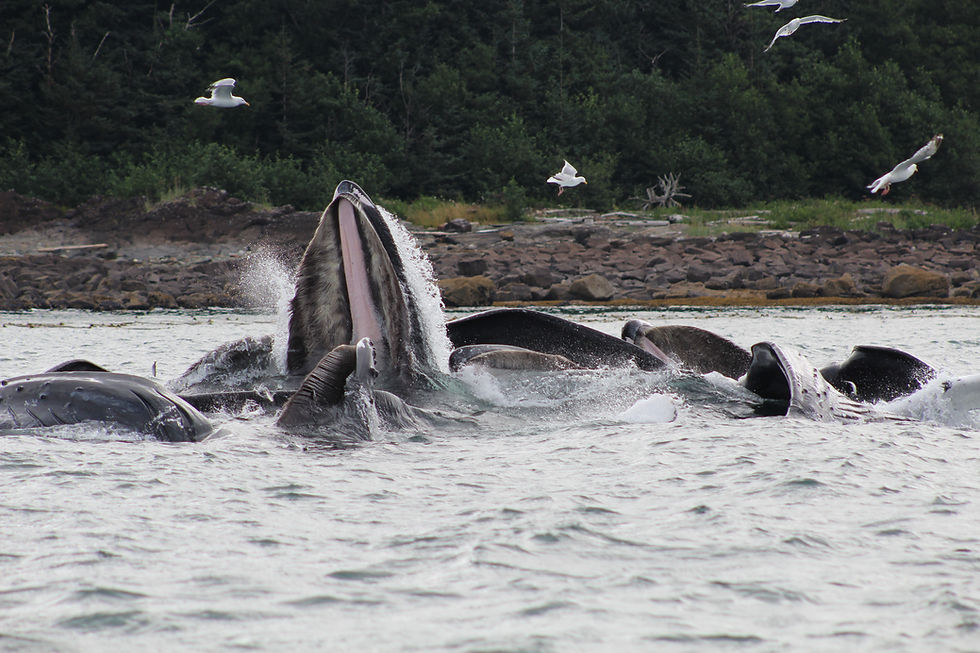
Whales and Dolphins (Extremely Likely)
I am excited to say it is extremely likely we will see multiple species of cetaceans (aka whales, dolphins, and porpoises)! July is the peak season for migratory baleen whales such as humpback, minke, and fin whales. It is also prime time for toothed whale species such as white-beaked dolphins, harbor porpoises, and orcas.
Humpback Whales: Humpbacks are common summer visitors to Disko Bay and the Nuuk Fjord system. As I can attest from seeing humpbacks in other feeding grounds, it is highly likely that we will see them feeding (including individual and group feeding known as bubble-netting), breaching, tail-slapping, and engaging in other wild, acrobatic behaviors. No matter how much time I spend around humpbacks, seeing them never ceases to amaze me. I especially love observing a species I know well in a new area. There are always behaviors I recognize as similar to Southeastern Alaskan humpbacks, but it is also fascinating to witness a familiar species in a new environment, noting their different behaviors and subtle physical differences.
Minke Whales: Under 30 feet, minkes are among the smallest of the baleen whales (blue whales are the biggest at 100 feet). I have read that minkes are active, curious, and frequently spotted in the fjords along our route. I have only seen a minke once in Juneau (a rare sighting for those waters), and it was neither active nor curious, as it was busy having itself a nice nap at the surface.
Fin Whales: Fin whales can reach lengths of up to 85 feet, ranking them as the second-largest animal on Earth (can you guess the first? It's mentioned above!). Fin whales have long, sleek bodies built for speed. We may encounter them feeding in large groups alongside other whale species like humpbacks and minkes (cool!). We are most likely to spot fins during the southern portions of our sail from Sisimiut to Nuuk. I have never seen a fin whale, and I will literally squeal at the sight!
White-beaked Dolphins: These dolphins are about 8 to 10 feet long and common in Greenland's waters. They usually travel in pods ranging in size from 5 to 30 individuals, but super-groups of over 1,500 have been recorded. They are known to be highly social and playful, and they love to "surf" the wakes of vessels and bow-ride! They have also been seen cooperatively feeding alongside other species such as humpbacks, fin whales, and other dolphins.
Harbor Porpoises: Harbor porpoises are small and typically shy cetaceans that are common throughout the global ocean. However, despite being a "common" marine mammal, there is still surprisingly little known about them.
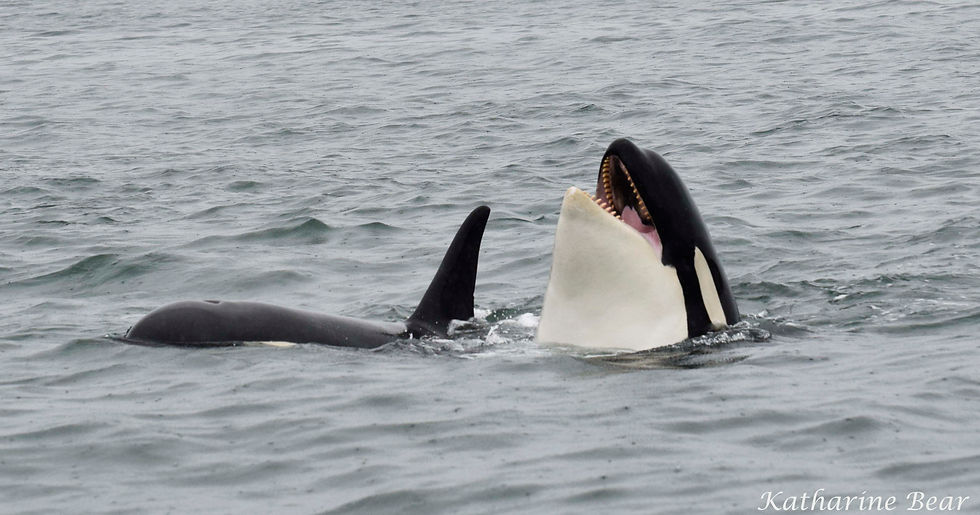
Orcas (aka killer whales): My heart skips a beat every time I see an orca, so I am excited to report that orca sightings—while hard to predict—are totally possible along our journey! Orcas are highly intelligent and complex animals with intricate social structures and behaviors. Orca families are even thought to have unique dialects and the ability to learn the languages of other pods.
An international body of scientists recently dedicated a whole meeting to trying to find a reason why orcas were intentionally striking yachts (many boats sank) around the Iberian Peninsula, and the best answer they came up with can be summarized as: "Because it is fun." Orcas are the ultimate apex predators, found throughout the entire global ocean. Their behaviors are constantly evolving and amazing the people who study them. Below, I will elaborate more about the types of orcas we might expect and how they differ from the ones I have seen in the North Pacific.
Orcas of the North Pacific are divided into strict ecotypes—mainly residents (fish-eating) and transients (mammal-eating). However, orcas of the North Atlantic are organized by the research community a bit differently: usually into Type 1 (generalists) and Type 2 (apex specialists). Yes, fellow orca-nerds, there is more nuance here, but that is not the point I am trying to focus on right now.
Type 1 orcas are famous around Norway and Iceland for herding prey like herring through "carousel feeding." This involves cooperatively corralling the fish and stunning them with powerful tail slaps (so cool!).
Type 2 orcas—otherwise known by me as complete badasses—are larger than Type 1 and strictly hunt other marine mammals, such as smaller whales and seals.
Both Type 1 and Type 2 are known to frequent Greenland's waters. Genetic sequencing and other distinctive traits confirm that the Type 1 orcas of Greenland are a distinct subgroup. Meanwhile, the Type 2 (badass) orcas of West Greenland are uniquely specialized ice-seal hunters, but they are also known to be highly successful at hunting narwhals and belugas. Orca families have perfected these hunting strategies over generations, passing this cultural knowledge down to their offspring.
Let me explain why orcas hunting seals is so fascinating. Orcas typically avoid swimming in dense pack ice because it can impair their echolocation, and they risk getting trapped, crushing their massive (up to 6-foot) dorsal fins, or drowning (remember, they are mammals and need to breathe!). Ice seals are smaller and much more nimble; they only need small breaks in the ice to surface for air and can easily haul out onto the floes to rest.
So, while pack ice is risky for orcas, it has historically been a safe haven for seals—except for when orcas decide to defy the odds. As the Arctic sea ice rapidly changes due to human-caused climate change (it's real), the Inuit have observed orcas around Greenland pushing deeper north and staying nearly twice as long as they did just two decades ago.
Scientists are actively working to model what ecological regime shifts this sudden influx of apex predators means for ice-dependent species like narwhals and belugas, which are already imperiled. One study predicts that a population of 150 to 190 orcas can consume over 1,000 narwhals in a single month. Orcas in other parts of the world are also known to kill for play (animals, not just boats) or for specific delicacies—like selecting only a shark's liver and leaving the rest behind (unbelievably rude).
Studies have documented that Greenland's orcas are experiencing severe biomagnification. When an orca eats a ringed seal, it inherits all the persistent organic pollutants (POPs), like PCBs and heavy metals, that the seal accumulated from eating thousands of fish. Because orcas have similar lifespans to humans (living up to 90 years), these toxins build up heavily in their blubber layer.
What about plastics? The orcas' prey are also eating the microplastics we will be sampling for on this expedition! We will be using FTIR (Fourier-transform infrared) analysis to document the polymer types of the plastics along our sailing route. This research highlights the many unknowns regarding the risks plastics pose to marine ecosystems and to us. (I'll do a deeper dive into the difference between biomagnification and bioaccumulation in a later post!)
Polar Bear (Nearly Unprecedented)
Polar bears love the ice, and they follow it north. Greenland's polar bears are heavily concentrated in the extreme North (where ice persists), the vast National Park in the Northeast, and along the Southeast coast. Our sailing route is just about the least likely place to see a polar bear in the summer. The west coast of Greenland—from Ilulissat to Nuuk—has no resident polar bear population in July. Local communities along this stretch rarely see them. If a polar bear does wander near a town like Nuuk or Sisimiut in summer, it is considered a major, highly unusual event.
Beluga (Highly Unlikely)
Belugas spend their winters in West Greenland, but by July, they have almost entirely migrated much further north (into the High Arctic or Canada) to follow the retreating pack ice. As early as May, they head to the shallow, warmer estuaries of the Canadian Arctic to nurse their calves. Many whale species migrate to shallower, warmer waters for calving and nursing to protect their newborns.
Narwhal (Extremely Unlikely)
arwhals are literally ice-obsessed. Like belugas, they spend winters in West Greenland, but by July, they have migrated far to the north into the High Arctic to stay close to the dense pack ice.
Narluga (LOL)
Yes, it's a totally real thing! Narwhals and belugas can occasionally mate and produce offspring, though it is incredibly rare. In the 1980s, a hunter in Disko Bay caught a bizarre, uniform-grey whale. DNA testing later confirmed it was a first-generation hybrid—the offspring of a female narwhal and a male beluga.
Walrus (Not this time of year)
Walruses throughout their global range are in trouble. Human activity and diminishing sea ice mean they are quickly losing habitat and are being forced to find new places to live. Greenland's walruses are no different. They spend their winters and spring in the shallow waters around Disko Bay, but they head out as soon as the ice breaks up. By July, they have already migrated far north or west. Seeing a walrus along our route in the summer would be extremely rare—and probably a stressful sign for the walrus.

Birds
Please forgive me, but I am not a true bird person. While I love seeing them, I won't be able to provide the same obsessive level of detail for our avian friends as I can for marine mammals. However, I can at least list the species we are likely to see and sprinkle in a few fun facts. Also, bringing it back to plastics— there's a lot of work being done characterizing plastics found in the stomach contents of dead birds.
Northern Fulmars: Albatross-like gliders that are famous for effortlessly following boats for hours on end.
Arctic Terns: Tiny but mighty! Greenland's Arctic Terns undertake the longest migration on Earth, traveling all the way from Antarctica to breed in Greenland.
White Tailed Eagles: The largest bird of prey in Greenland.
Arctic Skuas & Long-Tailed Skuas: Total punks. Instead of hunting for themselves, they are kleptoparasites—meaning they aggressively chase and bully kittiwakes and other smaller birds until they drop their catch (once again, rude).
Auks ("Arctic penguins")
I know this may ruin some childhood storybooks and cartoons, but there are no penguins in the Arctic. All penguins live in the Southern Hemisphere. However, birds belonging to the Auk family are commonly regarded as penguin-lookalikes. The species of Auk we are likely to see include:
Black Guillemots
Thick-billed Murres
Atlantic Puffins (omg, cute!)
Sea Ducks and Gulls
Common Eiders
Black-legged Kittiwakes
Iceland gulls and glaucous gulls
In many northern folklore, gulls are considered to be 'daughters of the sea.'
Sources:
Struzik, Ed. 2025. With Sea Ice Melting, Killer Whales Are Moving Into the Arctic. Yale Environment 360.
Letts, Daron. 2025 Orcas are moving north and styaing longer, researchers say. Nunatsiaq News.
Killer whales on the Greenland menu0a cause of concern. Aarhus University
The Circle: Walruses: Going with the floes? World Wildlife Foundation.
My brain and personal experiences :)

