Day by Day

I have to confess, I have been having a case of writer's block since returning from the Arctic. People have been asking me to tell them about the trip, and I am finding it difficult to answer. So here, I will provide a day-by-day account, referenced from the journal I kept along the way.
So let's start at the very beginning, a very good place to start.
Day 1: Ilulissat-- of ice and dogs.
Flying to Ilulissat from Oregon offers few route options. There was really only one flight that made sense, which was PDX-> Keflavik (Iceland)-> Ilulissat. The flight to Keflavik was a little delayed leaving Portland, which meant I was running through Keflavik airport to make the connection— there wasn't exactly another plane heading to Ilulissat if I missed it. It's fine; it's far from my first time running to a connection, and I doubt it will be the last. We boarded the small propeller plane pictured below after being bussed to the far reaches of the tarmac. I went outside the safety cones to peek inside the open luggage hatch, and much to my relief, I laid my eyes on my bright blue duffel bag. It would have been awful if my bag didn't make it since it had everything to keep me warm, including chocolate and rice crispy snacks (this is foreshadowing).

We arrived in Ilulissat little after 1pm local time. Almost the entirety of the Ilulissat airport is pictured below. I hadn't even met Liz yet, but here she was already photo-bombing my airport terminal selfie-- it's cool; we became good friends (this is also foreshadowing).

The first moment I knew this group of women were all going to be incredible was moments after we gathered in the Ilulissat baggage claim (there's only one and the belt is operated by hand). One by one we grabbed our bags. But one bag did not arrived-- it belonged to Waverly, a PhD student from the University of Georgia who will be analyzing the data collected on this trip. Not only did Waverly handle this nightmare situation with grace, but immediately all the women step up and offered Waverly extra socks, jackets, beanies, gloves, thermal layers, etc. Between the clothes Waverly managed to purchase and the borrowed clothing, she fortunately had enough to make it through the trip-- honestly she thrived.
I shared a taxi with some of the other crew into town. I had booked an AirBnB near the harbor for the one night I would have in Ilulissat before meeting with the rest of the guest crew and heading to Sea Dragon. The taxi dropped us at a hotel that appeared on the map to be very close to my AirBnB. However, the only directions I had from the host was a picture of a staircase and a note that

said "the door at the bottom of these stairs." I thought— well if the host is giving this level of information, it surely cannot be that hard to find. So I set out walking along every staircase in the harbor....until the host responded that it was near the coffee shop. There is only one coffee shop, so those directions were crystal clear. I found the whole situation to be hilarious and I retraced my steps carrying a backpack on my front and back. Honestly, I was enjoying the walk and it was gorgeous.
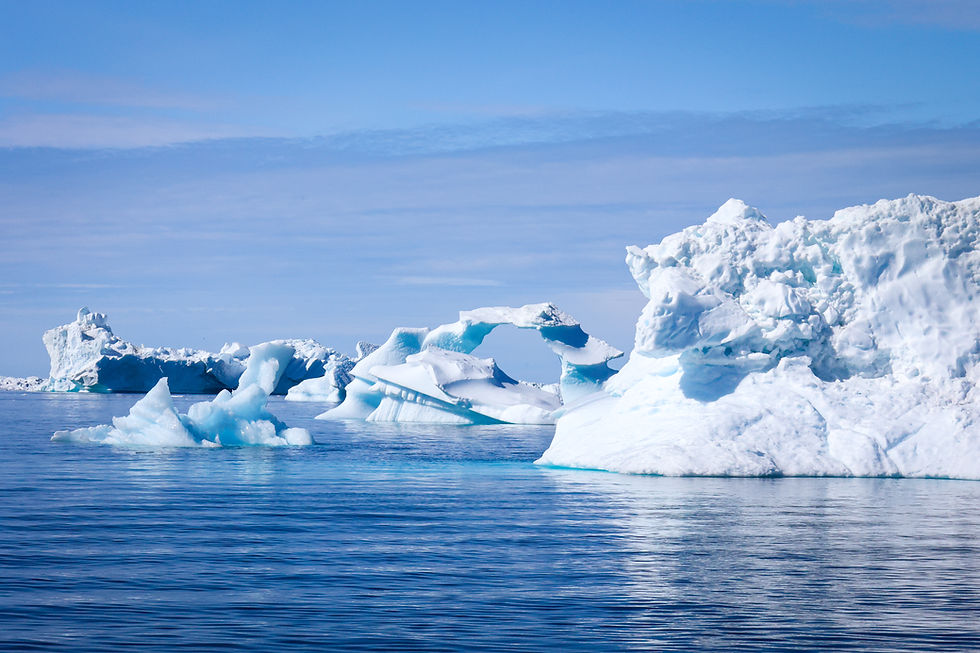
Ilulissat is Greenland's third largest town with a booming population just over 5,000. There are also about as many sled dogs. The town is absolutely beautiful with Scandinavian-style homes all painted bright colors. Ilulissat is the Greenlandic word for "icebergs"— Greenlandic is a very literally language— there are so many, literally, so many icebergs. The icebergs are shed from the Sermeq Kujalleq glacier. Locals told us that while there are always icebergs, this volume and magnitude of these icebergs is very uncommon and a result of climate change (foreshadowing again). The ocean and air are much warmer and the glacier is shedding ice at an alarming rate.
Once I arrived at my AirBnB, about 3pm, I dropped all my bags and put on my hiking boots. It was an exceptionally beautiful day and there was plenty of daylight left— so it was the perfect time for hike. I met up with Natalie, Lyssa, and Liz and we set out through town to the trailhead. Along the way to the trail, we passed two sled dog camps.


Greenlandic sled dogs are considered working animals— they are bread for sledding and hunting. They are kept in large packs in permitted areas of town where the adults are tied up to prevent them from wondering to other packs and fighting. These are high energy dogs who want to run. In the summer, they are long for winter races and work. Some sled dog owners have summer camps where they take tourists sledding. It is clear the dogs are loved and their handlers depend on them.

I quickly learned that my hiking companions are just as dog crazed as I am. We spent probably about 10 minutes just admiring these pups and taking photos.
Just after this dog camp, the trail began. The trail is best described as alpine— keep in mind we are in the Arctic Circle, there are no trees. It was very rocky and clear to see how it was craved by ice over the ages. At first glance, it would be easy to miss the diversity of plant life and vegetation. But with a closer look, there are wildflowers everywhere, but most are smaller than a fingernail and grow low to the ground. The trail meandered through two valleys before opening to the ice fjord, filled with icebergs. It was a warm day (about 60F). Something about being at such high altitudes makes the sun feel so warm when it is shinning. It felt so warm, I was hiking in short sleeves.

All of us were awestruck as the ice fjord first came into view. Excited, we hurried down the valley to the water. As we reached the water, I did as I always do on hikes when I find water— touch it. It was cold, but it felt so good on the warm day. I kicked off my shoes and socks and waded about knee high into the fjord until my legs went numb. It felt incredible. We enjoyed gazing out at the fjord, hanging out and climbing over the boulders for about a half hour before we realized it was getting close to 6pm and we wanted to make it back in town to watch a World Cup match.

Hiking with Liz, Lyssa, and Natalie felt like hiking with old friends rather than people I met only hours before. As we hiked, we talked about our lives at home, our motivations for coming on this trip, times of struggle, all while enjoying plenty of silly moments such as rolling around in Arctic Cotton Grass.

Although the trip had yet to begin, I felt like Greenland and my fellow crew mates were already special parts of my life.
Yes, that was all one day! About 10pm I headed back to my AirBnb after eating a very sad excuse for bar nachos. I Facetimed Tony back home in Newport to check in on the pets and show him the midnight sun. I took what would be my last shower for a week and headed to bed— with an eye mask to block out the light.
Day 2: Meeting Sea Dragon
Again, I loaded up my duffel bag and backpack and began the walk across the harbor to Hotel Arctic where I was to meet the rest of the guest crew, Winnie (our team lead), and Emily (founder of eXXpedition) on video call from the UK. The conference room where we met was bustling with energy— some a little nervous, some shy, some eager— but all with so much energy to set sail.

Due to the ice, the Sea Dragon was not able to make it to Ilulissat. Instead she was docked about a 2 hour boat ride away in a smaller town, Aasiaat. After our initial crew call we took our bags and boarded a power boat that would serve as our water taxi to take us south, through the ice to Aasiaat. This ride was spectacular.
Along the way I talked to our captain, and as it turn out those sled dogs we were taking pictures of the day before are his pack and they are not just the average sled dog— they are champions! For the past couple of years they have placed either 2nd or 3rd in the National Greenland Dogsled race.
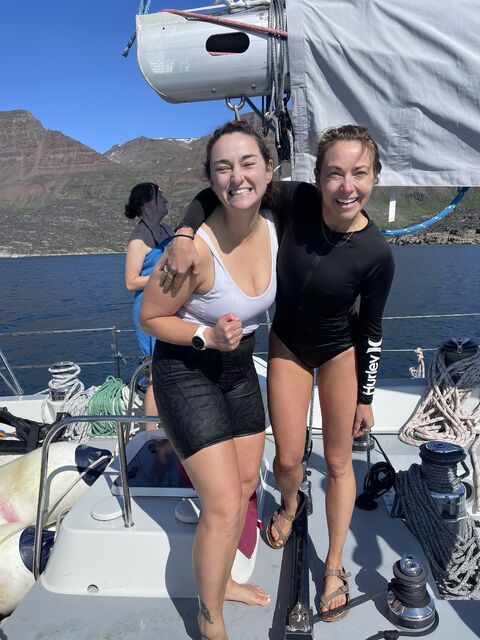
Once we arrived in Aasiaat, we immediately boarded Sea Dragon and met the professional crew: Skipper Ineke, First Mate Sarah, and Deckhand Jesse (they were all incredible). The work immediately started and did not stop for the next seven days.

Winnie showed us to our bunks and we were instructed to start unpacking and settling in. This alone was quite interesting. Unpacking meant putting what you need from your bag in a tub with a lid that is strapped down (the boat moves, can't have things flying everywhere), laying out your sleeping bag, and learning how to enter and exit your bunk. The bunks are flat but they are outfitted with a hammock contraption that in theory would prevent you from falling out of your bunk should the boat be swaying while you are sleeping. To enter my bunk, I needed to climb up and brace the edge of my left foot on a thin ledge, reach with my right arm to loop my index finger through a small hook, and slide in my bunk on my stomach. Once laying facedown on my stomach, I could make a few awkward movements and wiggle into my bag and roll onto my back. Fortunately, there was enough space in my bunk to sleep on my side with about 3 centimeters of clearance from my shoulder to the ceiling (not all were so lucky— ask Liz). Honestly, I found my bunk quite cozy once I adjusted to it— or maybe the secret is sleep depravation and anything can be cozy.
The night concluded with orientation to the boat, a wrenching lesson, safety briefings, and a detailed overview of the schedule and expectations of us for the days ahead.
Day 3: Unforgettable Disko Bay
We officially started underway at 6am. We were sailing back north, through Disko Bay to Qeqertarsuaq, a town on Disko Island. The day was so beautiful again, however there was no wind, which meant no sailing and we were forced to use the motor the whole day. One might say the weather was too good. Just outside of Aasiaat, we were greeted by a beautiful humpback fluke in the distance as well as many ringed seals.
Sailing (motoring) through Disko Bay was nothing short of unforgettable. I have been lucky enough to have a few experiences where a place makes me feel like I am on another planet— Disko Bay is one of those remarkable places. While in Disko Bay I kept thinking how amazing it is that I get to live in a world where things like whales and castle-like icebergs exist— and this is the very same planet home to elephants and gila monsters. It's absolutely incredible and precious, which is why it is so important for us to be here and try to make sense of the damage we are doing through something so convenient and simple as plastic.

Disko Bay is where we began our manta trawls for microplastics. A manta trawl is a special net with a wide mouth and tapered mesh funnel. The manta takes in sea water and filters out the microplastics with are collected in the end of the trawl. We tossed the manta overboard and trawled for 30 minutes and repeated this process three times.

That night we slept at anchor in the small harbor of Qeqertarsuaq. There was a small, compared to the castle sized iceberg in the bay, but large enough to to some serious damage to Sea Dragon if it collated with her, so we had shifts for 'ice berg watch.' My shift was around midnight. A few teenage boys in their dingys kept circling Sea Dragon but getting nervous when I waved at them. What an amazing way to grow up, taking your dingy's around the bay at midnight with your friends.
Day 4: On land in Qeqertarsuaq

Qeqertarsaq is a quaint and beautiful town that is home to less than 1,000 residents. We took the dinghy from Sea Dragon to the small dock to begin our day of beach, store, and town surveys. After walking all the way to the other side of town (about 10 minutes) we arrived at the beach where we would conduct our first beach transects. The sand was dark, tall but flat-top mountains lined the background, colorful homes dotted the shore, and of course there was ice. We promptly broke off into pairs to walk our designated transect and catalogue the liter we found. Most of litter we found was cigarette butts and small pieces of fishing line-- both of which are made with more plastic than you might realize.
I was partnered with Sandra. When you are sharing a sailboat with 15 people, there is not a lot of opportunity to have one on one conversations. So, having these moments to connect with Sandra was so extra special. As we collected cool rocks and sea glass we shared a F**K cancer moment that can only be shared between people who have lost their loved ones in this way. Sandra is the type of person that when she is near you, you find some inner strength you may have forgotten about or didn't know you had. If we could all be a little more like Sandra, the world be full of whit and laughter. She is really, like really, cool.
We also conducted store surveys, which literally means going to the store and systematically looking at what types of goods are sold and how they are packaged. We must have been a strange sight— a handful of American and European women dressed in bright yellow writing down how candy is packaged at the only grocery store in a town of 1,000. But the store was selling unlocked shotguns next to the produce— so we all have cultural differences.
While we were documenting how snacks are packaged in the store, another team spread out across town to record the types of litter that are found along the road sides. All these surveys (beach, store, town, and manta trawls) helps to understand what types of plastic are escaping the waste management system and identify what types of litter are most persistent. Litter is easy to ignore and pretend it doesn't exist, but once you start looking, every piece tells a story.

Qeqertarsaq also has a small research station for the University of Denmark. So we had the opportunity to talk with a scientist and some of his students that were on the island for a summer field course. We also met with a woman and her young daughter who lead an organization that educates the public about marine conservation and what should not be flushed down the toilet. There is no waste water management, so everything that is flushed goes directly to the sea. One of the main things they are trying to get people to stop flushing is "flushable wipes" as they do not breakdown in the environment and litter shorelines. PSA: even in America, do not flush 'flushable' wipes. They are lying to you!

Qeqertarsaq is charming. The mountains looked like enchanting places to hike. I think it would be a great place to spend more time. Before we made our way back to Sea Dragon, I stopped in the museum. I had a friendly chat with the man working the museum about hunting marine mammals and asked if they are concerned with funding plastic in their hunted foods. He wasn't personally too concerned about finding plastic in the stomachs of seals, but he talked about how they do find plastic in their fish. He also shared that narwhal is his favorite, walrus is a bit tough, and seal meat is best with wasabi— he offered me some if I stayed for dinner and considered becoming his son's new step mother. I declined this generous offer.
Day 5: South to Sisimiut, home of the whale church
The next port was Sisimiut, which is Greenland's second largest town of about 5,500 people. Sisimiut is stunning- it was one of my favorite stops in


Greenland for many reasons. One of the top reasons is the people. Walking through town people were so kind and curious as why were there and they were eager to talk to us about their town. We learned that the first church in Greenland, Bethel Church, is in Sisimiut and it was paid for in whale blubber. In 1771 the local sent 60 barrels of blubber to Copenhagen to pay for the timber to build the church. To enter the church, you walk under an arch of bowhead whale jawbones. Today, the church is a museum that has exhibits to teach about Greenlandic history and culture. In the museum I learned about Sanna/Sedna, the Inuit goddess of the sea. There are many stories about Sanna but the one I heard at the museum is summarized as: when the seal and whale hunting is poor, it is believed that the people have not properly cared for Sanna, the mother of the sea, and the marine mammals are entangled in her hair. A shaman should then enter a trance and visit Sanna and comb her hair and clean her house, releasing the marine mammals.
I would have been happy to stay in Sisimiut for several days and really get to know the town and hike the Arctic Circle trail. I can definitely see myself coming back to Sisimiut.

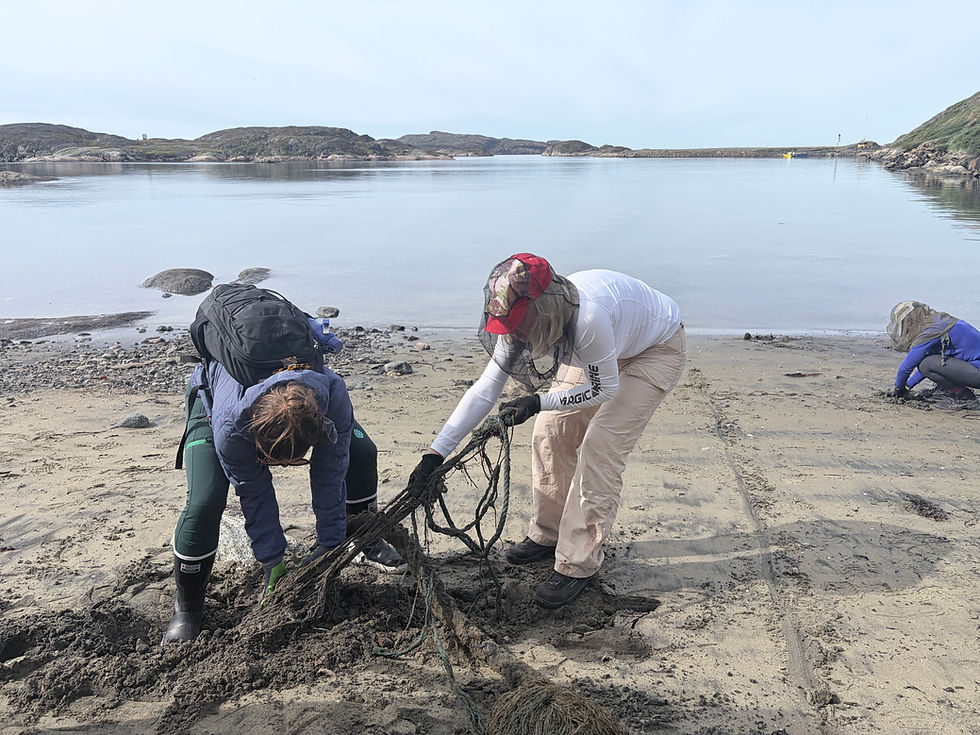
We were very busy for our few hours in Sisimiut— we toured the waste management system, did a beach transect and clean up, store surveys, and town transects. The beach we cleaned was located near the airport. It's a beautiful small beach in a tucked away cove. It has a few picnic tables and it is easy to see why local and visitors would enjoy spending a relaxing afternoon here. We hauled up about a dozen full bags of litter from the beach. Most of the litter was plastic films, ropes and fishing line, or other debris related to fishing.

Sisimiut is a hub for the Arctic as it's harbor is mostly ice-free in the winter, barges and ferries can access Sisimiut year-round. This is also one of the reasons that Sisimiut has a modern waste-to-energy incinerator plant for waste management. We all piled into trucks to head to the waster-to-energy plant, but there weren't enough seats in the trucks so I (ecstatically) volunteered to ride on the back of an ATV to the facility. We jokingly were calling it my Greenlandic Lizzie McGuire moment.
Touring the waste- to-energy facility was truly interesting and was a stark reminder of the reality and the complications of waste management. Almost everything in Greenland is shipped from somewhere else. Likewise, trash then needs to be shipped out or left in a landfill. As part of the Greenland's National Waste Management Strategy, two of these incinerators were built-- one in Nuuk, and the other in Sisimiut. The incinerator needs to be constantly running and is 'fed' waste of all sorts and then produces energy that is converted to heat for local residents. It is designed to process roughly 60 tons of waste daily. What can't be used for heat immediately is released into the atmosphere.


While it's easy to celebrate this cheap source of heat for the community, it's difficult to look past how this waste management process is actually a wicked reflection of a much more insidious and complicated problem of industrialization, climate change, and our modern society's gluttony and desires for manufactured products coupled with little to no extended producer responsibility for the waste that's being produced. We have to do better than creating 'solutions' of literally discharging heat into the Arctic, the ecosystem that is most rapidly from climate change. But this isn't just about the Arctic— it also about how we, in America, and other rich developed countries are managing waste. Do you know where your trash goes once it leave your curb-side collection?
Lyssa and I were partnered up for the town litter transects. Like I mentioned before, there's few opportunities for one on one connection during a trip like this. So walking through Sisimiut with Lyssa was a gift. The world is a better place because people who are as calming but also as charmingly feisty as Lyssa exist. Before returning to Sea Dragon Lyssa and I visited a bakery and a local artist gift shop— delicious and beautiful.
Day 5-8: Sisimiut to Nuuk, loosing all concept of time
Leaving Sisimiut, we knew we were in for the longest run of the voyage without coming to land. The Sea Dragon needed to run 24-hours a day, which meant we were broken up into 3

teams with each team lead by a member of the professional crew. The schedule was 3-hour watches— so broken up across 3 teams, this means your team is on watch for 3 hours and then off for 6 hours. What this means in reality is that you are awake with your team for 3 hours running the boat and doing whatever chores and cooking needs to be done, and processing plastic samples in the FTIR, and then immediately crawling into your bunk and sleeping- or at least trying- for 6 hours, and then repeat. This schedule and the 24-hour daylight left me feeling incredibly disoriented and I lost all perspective and concept of a "day." The first few shifts like this were somewhat challenging but my body quickly adjusted to this rhythm and I felt like I could have existed like this for another week— once you have completely lost track of a clock and days to this extreme there really is no difference between 3 days or a week. Watches were actually quite fun. I had a stellar crew to work with and I really enjoyed the full transformation into a salty sailor drinking tea at the helm. Plus, there are certain magical moments like distant whales and the solar sunrise/sunset where the sky is vibrant hues of pink.
It was during this segment that we crossed the Arctic Circle, which means a blue nose ceremony was in order! Skipper Ineke initiated the maritime tradition by reading a message that suddenly appeared on her phone from Boreas Rex, the King of the North. Boreas wanted to let us know her was pleased with us coming to his sea to learn more about plastic pollution and wished us well as we left his domain and entered the territory of Neptune.

Nuuk and Heading Home
Anchored in the Nuuk harbor, we had one last night sleeping on the Sea Dragon before truly bringing her dockside and saying goodbye. But there was still work to be done— so we took a dinghy ride into Nuuk, were we promptly split into teams to conduct, beach, store, and town surveys.
I was on the beach survey team. Nuuk does not have many accessible beaches, but we found our spot. This beach is a small cove that located almost directly underneath the airport. There is a small sauna available for rent for people to go for ocean cold plunges and then warm up in the sauna. Kitted out in our bright foulies, walking the beach collecting litter was really ruining the ambiance for the sauna-goers.

The last night abroad the Sea Dragon was bittersweet. But we finally had a moment to relax and just enjoy each others company as the good friends we have all became. Leaving Sea Dragon and seeing everyone depart in separate taxis certainly brought a tear to my eye—but damn did that first shower in my AirBnB feel amazing. That night, we met for one last crew dinner, at a proper restaurant, and then truly said our farewells.
I had a couple extra days in Nuuk and fortunately so did Liz! We spent the next two days exploring Nuuk, visiting museums, art centers, record stores, cafes, and shopping for presents to bring home. The weather seemed to be turning worse by the hour and it wasn't long before we learned our flights home had been cancelled. Fortunately Liz and I are experienced travelers and a few laughs and cups of tea later we had a plan to get home. The new plan invovled a round-about

involved a round about journey to Copenhagen first. But alas, we made it safely home.
This entire trip was an incredible experience of exploring, connecting, and growing. On my final return flight home from London to Portland, we flew directly over Disko Bay and from the plane window, I could see the ice. Seeing these same waters from a sky-high view granted a quiet moment of reflection making me appreciate just how big and how small this interconnected world truly is.
In the days when maps were being drawn for the first time, uncharted waters would often be depicted by illustrations of dragons and sea monsters and accompanied by the phrase here be dragons. Leaving this trip, I made a few promises to myself— about science, about bringing these learnings home, adventuring more, and some other avenues to explore. So while this trip came to end, I feel as if some headings to uncharted waters are only beginning. So Here Be Dragons.